

UN HLPF Side Event Links Accountable AI, Sustainable Development and Youth Participation

Xing TANG, Chairman, Grouphorse Group

Mario BAEZ, Former Chief, Accountability Service, United Nations Secretariat
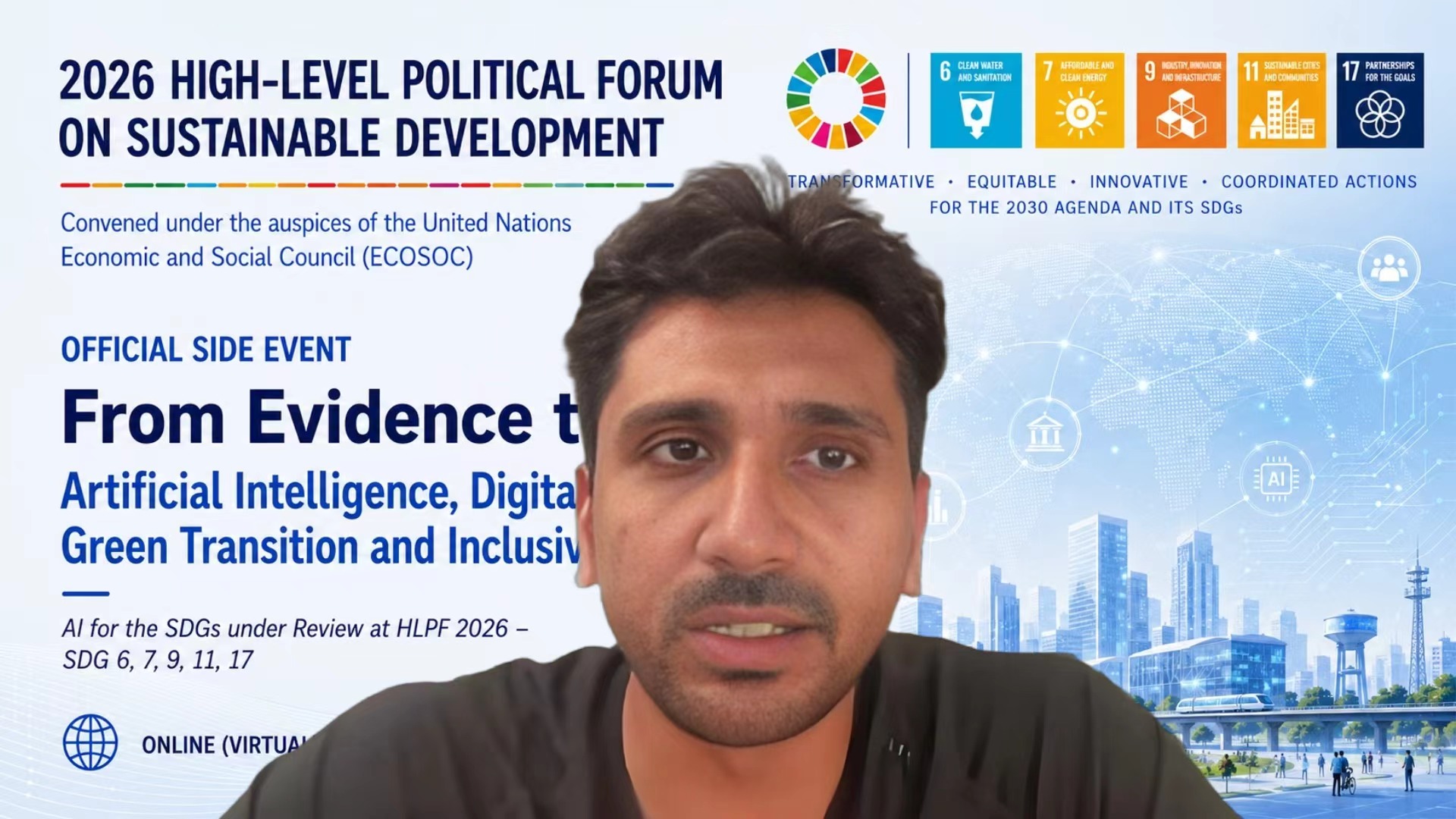
Akhil SHARMA, Senior Software Engineer, Meta
The virtual event, "From Evidence to Action: Artificial Intelligence, Digital Governance, Green Transition and Inclusive Infrastructure," was co-organized by the Tianjin Eco-city Friend of Green Eco-Culture Promotion Association and Grouphorse Group. It addressed SDGs on water and sanitation, clean energy, innovation and infrastructure, sustainable cities and partnerships.
The session was moderated by Lingxin Guo, Director of AI Data and Strategic Partnerships at Grouphorse Group.
In opening remarks, Xing Tang, Chairman of Grouphorse Group, said AI, digital governance, green transition and inclusive infrastructure should be treated as interconnected policy areas. Technology can accelerate action, he said, but governance must define responsibility and inclusion must determine who benefits. He said the central challenge before 2030 is not a lack of evidence or solutions, but converting them into action at the speed and scale required without compromising accountability, inclusion or trust.
Tang added that trustworthy AI depends on accurate, responsibly governed and culturally representative data. Languages, cultures and lived experiences missing from training data risk also being excluded from the benefits of technological development.
Mario Baez, former Chief of Accountability Service of the United Nations Secretariat, called for stronger oversight of algorithms used in public policy, resource allocation and essential services.
Baez said institutions deploying AI should maintain dedicated risk registers covering data sources, bias, cybersecurity, transparency and social impact, backed by independent mechanisms linking problem identification, corrective action and verification. Machine-learning complexity, he said, must not become a shield against public accountability.
Akhil Sharma, Software Developer at Meta, discussed the responsibilities created when AI systems operate at global scale.
Even systems with high overall accuracy can affect large numbers of people, Sharma said. Safety, data quality and accountability should therefore be built into system design and model training. He proposed lighter controls for low-risk uses, human-final decisions in areas affecting rights or finance, and clear human leadership in health and safety applications.
Thinkwell Jamera, Trustee/Director of the Association of Health Care Professionals in Jersey, Channel Islands, and a medical doctor, educator and researcher, said AI should strengthen understaffed and resource-constrained health systems rather than mainly improve efficiency in already well-funded institutions.
Jamera said AI can support care but cannot replace communication, ethical judgment, informed consent or attention to a patient's circumstances. He called for clinical validation, data protection, bias assessment, professional supervision and an identifiable human decision-maker.
Seven youth representatives then spoke in the following order, each connecting AI governance with a specific social or sustainable-development challenge.
Hanyu Li, a student at Shanghai Qingpu Pinghe Bilingual School, examined AI-generated images and fake news. She urged the public to move from "seeing is believing" to "verification is believing" by checking sources, comparing authoritative reports, examining visual details and using verification tools.
Yixin Chen, a student at Shanghai Starriver Bilingual School, argued that smart cities should not be assessed only by traffic efficiency, connectivity and automation. She proposed adding social cohesion, community participation, loneliness and mental-health indicators so urban technology is evaluated against human well-being. She added that a city can be digitally efficient yet socially disconnected, and argued that public policy should treat human connection and mental health as core infrastructure outcomes.
Nan Jiang, a student at Shanghai Starriver Bilingual School, examined hostile architecture, including divided benches and anti-sleeping devices. She said such designs can exclude unhoused people, older residents and other vulnerable groups, and called for inclusive public facilities, reuse of idle urban spaces and stronger social support instead of spatial displacement.
Wendy Zhang, a student at St. Joseph's Institution International in Singapore, addressed barriers to young women's economic participation. She advocated gender-equality education, greater transparency in pay and promotion, and cross-border mentorship networks that can help young women enter and advance in the workforce.
Kangyue Liang, a student at Shanghai Starriver Bilingual School, linked algorithmic governance to the survival of intangible cultural heritage, in support of the HLPF 2026 review of SDG 11. Drawing on fifteen years of Chinese dance training and field study of Muqam culture in Xinjiang, she said platforms optimized for clicks and watch time can compress historically layered traditions into decontextualized "three-second spectacles."
Liang proposed a "Contextual Integrity Standard" for heritage digitization and platform dissemination: historical background, ritual structure, community meaning and the voices of cultural bearers should be preserved, and content metrics should assess whether essential context survives digital dissemination.
Zhaomeng Zhang, a student at the University of International Relations, drew on Chinese smart-city and sponge-city practices to propose three principles for AI-supported urban governance: accountability, inclusive data and citizen participation. She said technological advancement alone does not make a city sustainable; systems must respond to different communities, permit public scrutiny and improve efficiency without sacrificing fairness.
Wenwen Jiang, a student at Shanghai Soong Ching Ling School, addressed cultural diversity and creators' rights in generative AI. She called for consent, attribution and fair compensation when creative works are used for training, together with disclosure of data sources and clear labeling of AI-generated content. She also urged UNESCO, WIPO and ITU to coordinate content-provenance standards to protect creators, smaller languages and less widely represented cultural traditions.
In closing remarks, Yujie Chen, a United Nations project design consultant, said the discussion linked institutional oversight, responsible engineering, healthcare governance and public participation. Young people, she said, should be treated not only as technology users or future beneficiaries, but as current stakeholders in rule-making, system design and project evaluation.
Participants called for sustained cooperation among international organizations, governments, technology companies, healthcare institutions, schools, universities and civil society. They urged decision-makers to assess AI projects against verifiable social and sustainable-development outcomes rather than technological capacity alone.
Bill Tang
Grouphorse
email us here
Legal Disclaimer:
EIN Presswire provides this news content "as is" without warranty of any kind. We do not accept any responsibility or liability for the accuracy, content, images, videos, licenses, completeness, legality, or reliability of the information contained in this article. If you have any complaints or copyright issues related to this article, kindly contact the author above.
